Categories: Recipe

Boterkoek: Dutch Butter Cake

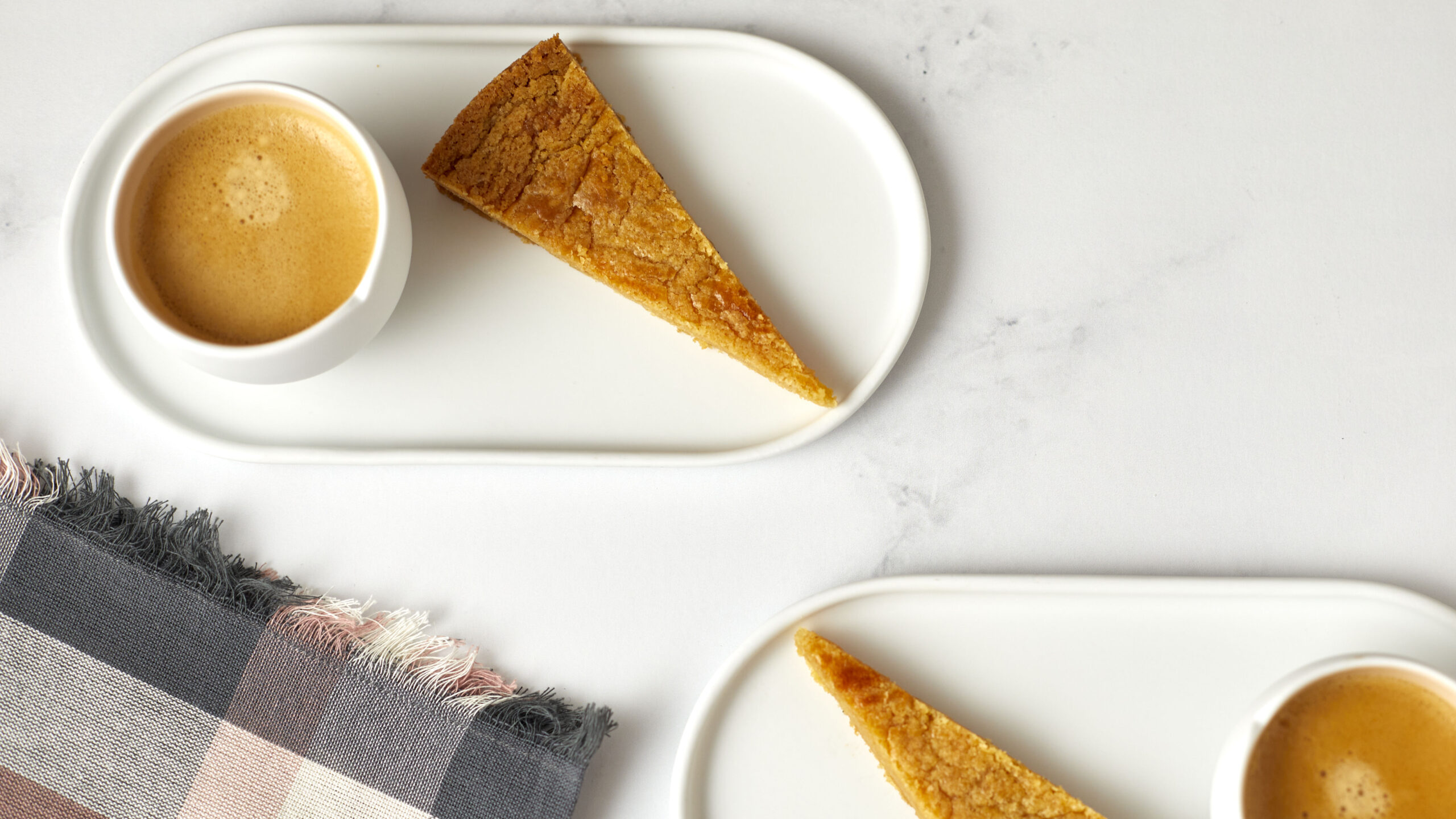
It’s hard to explain what “boterkoek” is… it’s neither a cookie nor a cake. Literally, it translates to “butter cookie,” or “butter cake.” but I believe it’s unique. The closest resemblance is probably a bar cookie.

This is a fantastically rich, moist, dense, and buttery baked good. It pairs great with a cup of coffee. Growing up, whenever we would have company coming over, my mom would bake these, and offer people “iets lekkers bij de koffie?” (Literal translation: “would you like something tasty with your coffee?”) The recipe came from our old neighbor, and it is absolutely delicious!

Print Add to Collection Go to Collections

Boterkoek: Dutch Butter Cake

Boterkoek.... what is it? Literally, it translates to "butter cookie," or "butter cake." To me, though, it is neither; it's something unique. My wife says it most resembles a bar cookie. Whatever it is, it is a rich, luscious, buttery baked good that is great with a cup of coffee! Be aware, though, it's very rich, so a small piece goes a long way!
Course Dessert, Snack
Cuisine Dutch
Keyword Baking, Butter, Cake, Dutch Food
Prep Time 15 minutes
Cook Time 30 minutes
Total Time 45 minutes
Servings 16 Slices
Calories 391kcal

Ingredients

Boterkoek

  • 500 g Self-rising flour
  • 200 g Superfine sugar (caster sugar / witte basterdsuiker)
  • 180 g Sugar
  • 400 g Unsalted butter
  • 2 Egg
  • 1 pinch Salt
  • some Unsalted butter To put on the cake pans
  • some all-purpose flour To dust on the cake pans
Get Recipe Ingredients

Instructions

Making Boterkoek

  • Preheat your oven to 175C ( 350F) non-convection. If you want to use convection, lower the temperature to 160C (325F).
  • Grab two small bowls, and separate one of the eggs: put the yolk in one bowl, and the whites in the other. Crack the second egg in the bowl with the yolk.
  • Rub the cake pans with butter; make sure it's fully covered. Then dust them with flour.
  • Melt the butter on the stove over low heat.
  • In a large bowl, sift together flour, caster sugar, sugar, a pinch of salt.
  • Add melted butter, and by hand, mix it all together until the dough and sugar are fully hydrated and combined.
  • Add one egg yolk (and some of the white) to the dough, and mix it through by hand. When the first yolk is fully combined, add the rest of the white and the second yolk. Mix it through by hand until fully combined.
  • Split the dough in two, and put them in the cake pans. Push it in so it's evenly distributed.
  • Beat the egg white until it's smooth, and brush it on the two boterkoeken.
  • Put the pans in the oven for 15 Minutes.
  • Open the oven, and with the back of your spoon, push the dough down. One of the characteristics of boterkoek is that it's very dense, and by pushing it down, you are achieving a dense texture.
  • Put the pans back in the oven for 10 Minutes.
  • Open the oven, and with the back of your spoon, push the dough down again.
  • Put the pans back in the oven for 5 Minutes
  • Open the oven, and with the back of your spoon, push the dough down again. Check the color, and if it's a nice golden brown, you can take them out. Otherwise, leave them in a bit longer.
  • When they're golden brown, take them out of the oven, and let them cool down fully.

Plating

  • This is typically served with some coffee. Slice a small wedge or square, and serve it with a nice, hot, cup of coffee!

Video

Nutrition

Calories: 391kcal | Carbohydrates: 46g | Protein: 5g | Fat: 21g | Saturated Fat: 13g | Polyunsaturated Fat: 1g | Monounsaturated Fat: 6g | Trans Fat: 1g | Cholesterol: 74mg | Sodium: 14mg | Potassium: 45mg | Fiber: 1g | Sugar: 24g | Vitamin A: 655IU | Calcium: 14mg | Iron: 0.4mg
Toine

View Comments

  • I‘ve had Dutch Boterkoek. Love it! I’m wondering about a couple things:

    1) Why do you use self-rising flour if you want it to stay dense, so you have to keep pushing it down as it cooks?

    2) Why do you use two different kinds of sugars? What does that do for the dough?

    3). How do I know when there is too much fat in butter and so I should cut back the amount?

    • 1 / 2) That's what my mom, and grandma used... I have learned to not question them :-)

      3) I know it by feel when kneading the dough, if the fat doesn't incorporate into the dough.

Recent Posts

Kip Saté kroket: Dutch Croquette made with Chicken in Indonesian Peanut Sauce

Learn to make a satékroket, the Dutch snackbar croquette filled with chicken in Indonesian peanut…

2 weeks ago

Wentelteefjes: Dutch French Toast

Wentelteefjes are Dutch French toast made from day-old white bread, fried in butter and finished…

4 weeks ago

Keizerbroodjes Recipe: Hand-Folded Kaiser Rolls

A proper keizerbroodje wasn't going to show up on a hospice cafeteria tray, so when…

1 month ago

Homemade Chocoladeboter: Real Butter Dutch Chocolate Spread

How to make chocoladeboter at home with real butter instead of margarine, a firm, cocoa-forward…

1 month ago

An Update, and the Rest of the Story

Back in January, I wrote a short post called "Taking a Moment, With Gratitude." I…

3 months ago

Eierkoeken Recipe: How to Make Authentic Dutch Egg Cakes at Home

Learn how to make eierkoeken — soft, pillowy Dutch egg cakes with golden edges and…
6 months ago