Ingredients

Equipment
Before you Start
- This takes two days. The filling has to set overnight before you can shape it, and the shaped kroketten need another two to three hours in the freezer after breading. Neither one can be shortened. Start on a Friday and fry on a Saturday.
- This is harder than a beef kroket. The fat and sugar in the peanut sauce make the filling softer and stickier, and a soft filling is a filling that bursts in the oil. Rolling the logs takes more patience than you expect. Most of the steps here exist to prevent a burst, so follow the chilling and freezing times even if it looks firm enough.
- The bumbu is ground by hand in a molcajete or a mortar. A blender or a food processor will chop lemongrass but never break it down, and this recipe has no long simmer to soften what the grinding missed. Allow ten minutes for it.
- Use plain fine dry breadcrumbs. Not panko, which gives a coarser crust than a Dutch kroket should have, and nothing seasoned. Buy more than you think you need, because once egg gets into a dish of crumbs that batch is finished.
- The one moment you cannot recover from is the seasoning. Once the filling goes into the refrigerator it is set. Taste it while it is still warm and loose.
- Gula jawa, tamarind paste, fresh galangal and lemongrass are the ingredients you may have to go looking for.
Method
Poach the chicken
- Put the water and the bouillon cube in a saucepan and add the chicken breast, fully submerged. Start it from room temperature water rather than dropping the chicken into boiling liquid.
- Bring it to a rolling boil, drop the heat to a slow simmer and cook for 10 minutes. Turn the heat off, cover the pan, and let it sit for another 10 minutes. Check that it reads 74°C (165°F) at the thickest point.
- Keep the poaching liquid. That is your broth for the roux, and it carries the chicken flavor that a bouillon cube on its own will not give you.
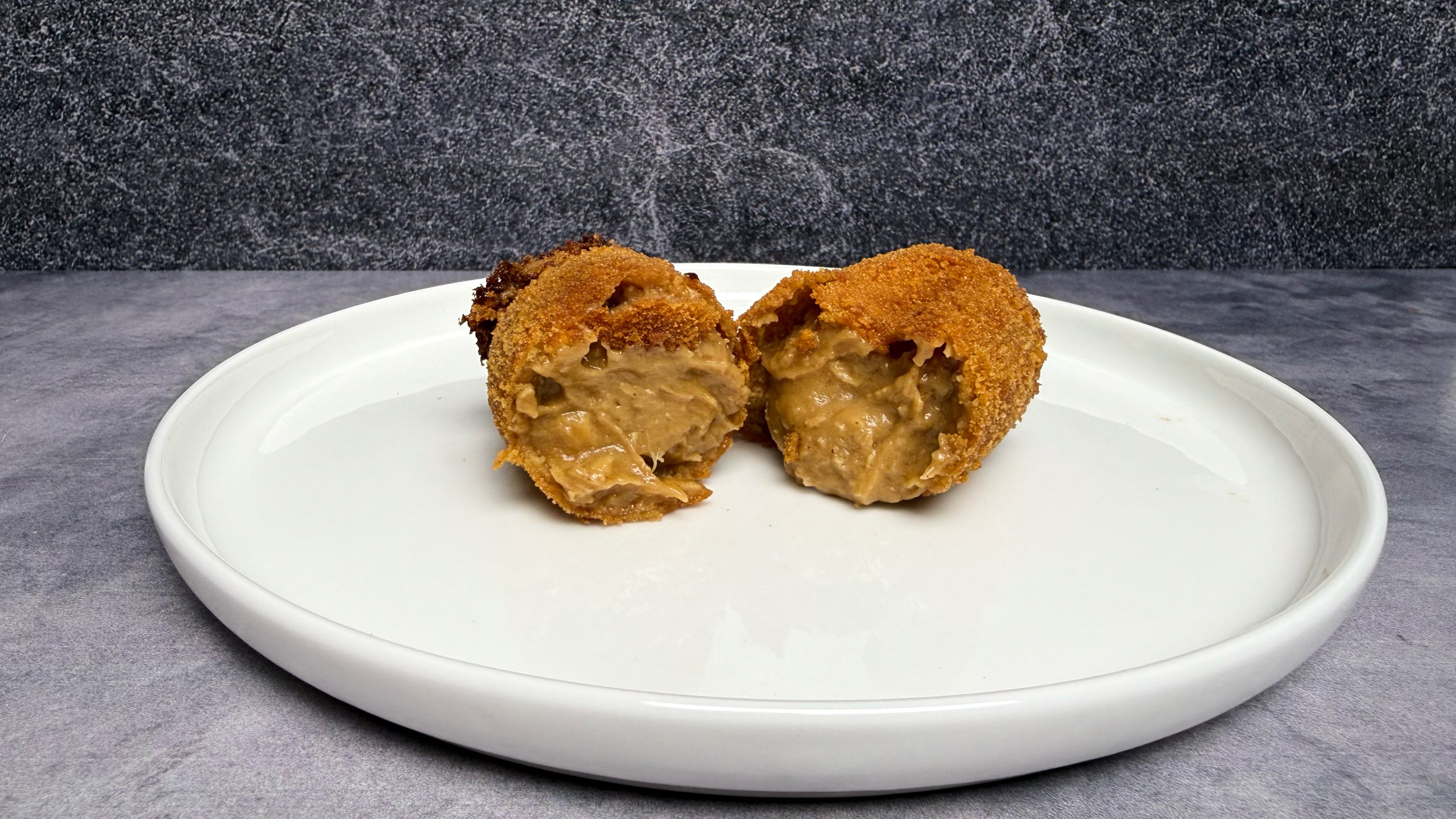
- Chop the chicken into rough quarter-inch dice. Do not shred it. Breast tears into stringy fibers when you shred it, and those fibers give you nothing to bite into. Dice holds its moisture and you can see it in the cross section when you break a kroket open.
Make the bumbu
- Slice the tender core of the lemongrass as thin as you can, across the grain, and slice the galangal thin as well. This is most of the work and it is worth taking your time over. Whole chunks skate around a wide stone instead of breaking down.
- Grind the lemongrass and galangal together first, until there are no recognizable pieces left. These are the two fibrous things in the paste, so getting the hard work done in one pass gives you a broken-down base to add everything else to. The rough stone tears the fibers rather than just crushing them, which is what they need. A blender or a food processor will chop lemongrass and never break it down, and undermilled lemongrass leaves splinters in the filling. If you are using frozen galangal, let it thaw first. Frozen is good for grating and bad for grinding, because it skids instead of yielding.
- Work in the garlic, then the shallots, then the ground coriander. Softest and wettest last, so the liquid the shallots give up loosens the paste rather than getting in the way early on. Grind until it comes together as one paste, and push it through a sieve if it still feels fibrous.
- Heat the neutral oil in a wide pan over medium heat and fry the paste for 6 to 8 minutes, until the raw smell of shallot and garlic is gone and the paste has darkened. Do not rush this. Underfried bumbu tastes sharp and green, and there is no long simmer later on to fix it.
- Nothing sweet or sour goes in the pan at this stage. Gula jawa and tamarind would both scorch well before the shallot and garlic are cooked out. They go in later, off the heat.
Make the filling
- Add the butter to the same pan and let it melt into the fried paste. The butter goes in after the frying rather than before it because butter burns well below the temperature a bumbu needs. Fry in oil, finish in butter, and you get both.
- Whisk in the flour and cook the roux to blonde, a couple of minutes longer than you would for a beef kroket. Stop there. A darker roux tastes better and thickens worse, and this filling needs all the binding it can get.
- Strain the broth into a measuring cup so it goes in clear.
- Add the broth a little at a time, whisking as you go. It thickens fast. Let it come to a gentle boil and cook it through until it coats the back of a spoon.
- Take the pan off the heat and stir in the peanut butter, gula jawa, tamarind, ketjap manis and sambal oelek. The peanut butter goes in cold from the jar, which brings the temperature down on its own.
- Bloom the gelatin in the room temperature water for 10 minutes while the filling cools.
- Check the temperature of the filling before the gelatin goes anywhere near it. You want it between 60 and 70°C (140 and 160°F). Too hot and you cook the setting power out of the gelatin, which is the difference between a filling you can roll and one you cannot. Too cool, below about 50°C (120°F), and it will not dissolve properly and you get rubbery streaks. Stir it in until it has completely disappeared, and do not put the pan back on the heat afterward.
- Fold in the chopped chicken. Gelatin first, chicken second, because gelatin is much easier to disperse evenly without pieces of meat in the way.
- Taste it now, while it is still warm and loose. This is the only real chance you get. Watch for tamarind that has gone sharp, for the ketjap manis and gula jawa stacking up too sweet together, and for salt. Push the heat slightly past where you want it, because chilling mutes the sambal.
- Spread the filling into a shallow dish, press plastic wrap flat against the surface so no skin forms, and refrigerate overnight.
Shape and bread
- Whisk the eggs and milk together in a shallow dish with a pinch of salt. Put the breadcrumbs in another dish.
- Weigh the set filling and divide it into portions of about 85 g. Roll each one into a log, around 10 cm long and 3 cm across (4 inches by 1¼). This is harder work than a beef kroket. The peanut sauce makes the filling stickier and it does not want to hold a shape as readily. Put the shaped logs back in the refrigerator for a few minutes if they soften while you work.
- Bread each one in this order: breadcrumbs, egg, breadcrumbs. The first coat of dry crumbs is what gives the egg something to grip.
Freeze
- Lay the breaded kroketten on a lined cookie sheet, not touching, and freeze them solid. Two to three hours minimum for a log this size. Bread first and freeze after, in that order. A frozen crust sets in the oil before the filling behind it has softened enough to find a weak spot, and that is the whole reason this step exists.
- You do not have to fry them all now. Once they are frozen solid, bag them and keep them for a couple of months, then fry two at a time straight from the freezer whenever you want them.
Fry
- Fill a Dutch oven no more than halfway with oil and bring it to 175°C (350°F). The level rises when you add the kroketten and you do not want it going over the side. If you are using a deep fryer, follow the manufacturer's fill line.
- Fry straight from the freezer, one or two at a time, for about 5 minutes, until deep golden brown. Frozen takes longer than thawed would, around 5 minutes against 3, and the extra time is heat working through the ice. Work in small batches so the oil temperature does not crash, and let it come back up to 175°C between batches.
- Drain on a wire rack set over a paper towel lined sheet. Fish any loose crumbs out of the oil before the next batch goes in, or they will burn and stick to the next kroket.
Nutrition
Notes
Ingredients that are hard to find in the US
Gula jawa is Indonesian palm sugar, sold in hard discs or short cylinders at Asian groceries and online. Dark brown sugar will work, but the flavor is flatter and you lose the smoky note.
Ketjap manis is sweet Indonesian soy sauce and it is not interchangeable with regular soy sauce. If you cannot find it, make your own.
Sambal oelek is stocked in a lot of American supermarkets now, and it is easy enough to make if yours does not carry it.
Tamarind paste gives the sourness. There is no good substitute for it here.
Galangal is not ginger and they do not taste alike. Frozen galangal works well, but thaw it before it goes in the mortar. Dried ground galangal is a distant third and you will taste the difference.
Lemongrass is sold in stalks in most large supermarkets now. Asian groceries also sell it minced in jars or frozen as a paste, and either is a fair answer if you do not want to grind it yourself.
If you do not have a molcajete or a mortar
A spice grinder is the next best thing, and it works much better if you freeze the sliced lemongrass for half an hour first. Frozen fibers shatter instead of squashing. Pulse in short bursts and shake the grinder between them rather than holding it down. Lemongrass oil lingers in a blade grinder, so wipe it out afterward and run a spoonful of plain rice through it before you grind spices in it again.
If the filling is too sticky to bread
Chill it longer. If it is still difficult after a full night, stir a little more flour into the next batch rather than more gelatin. Extra gelatin gives you a bouncy, rubbery interior instead of a creamy one.
Why yours will not be the color you remember
Snackbar satékroketten often have a crust in a different shade from the beef ones. That is a factory convention so that staff and customers can tell varieties apart when they are in the same fryer basket, and the same logic is why a nasischijf and a bamischijf are different colors. It is not part of the recipe and no home version reproduces it. Yours will look like a plain kroket.
Freezing ahead
These are built to be frozen, so make the full batch even if you only want a few now. Freeze them breaded on a sheet until solid, then bag them. They fry straight from frozen at 175°C (350°F) in about 5 minutes and will keep for a couple of months.
Chicken thigh
Thigh holds up better than breast in a filling like this and is worth using if you prefer it. Breast works here because the fatty sauce and the overnight chill both work in its favor.
