Ingredients

Equipment
Method
Preheat the oven and prepare your baking sheet.
- Set your oven to 180°C (350°F) for a conventional oven. If you are using a fan-assisted or convection oven, lower that to 165°C (330°F). A fan oven circulates hot air more aggressively, and while that is great for even baking, it can cause the tops of your eierkoeken to set and color before the inside has had time to cook through properly. The lower temperature compensates for this.
- Line your baking sheet with parchment paper or a silicone baking mat and set it aside. You want this ready before you start mixing, because once the batter is done it should go into the oven without too much delay.
Make the Batter
- Bloom the lemon zest into the sugarAdd the granulated sugar and the vanilla sugar to the bowl of your stand mixer, or the bowl you will be using with your hand mixer. Zest half of a washed lemon directly into the bowl, right on top of the sugar. Using your fingertips, rub the zest into the sugar for about 30 seconds. You will feel the sugar become slightly damp and clumpy, and the smell in your kitchen will change noticeably. What you are doing is breaking open the tiny pockets of essential oil in the lemon zest and releasing them directly into the sugar. This distributes the lemon flavor much more evenly throughout the batter than simply adding zest at a later stage would. It is a small step that makes a real difference.
- Beat the eggs and sugar until pale and thickAdd the three eggs to the bowl with the lemon sugar. Fit your stand mixer with the whisk attachment, or hold your hand mixer over the bowl, and begin at medium speed for the first minute to bring everything together. Then increase to high speed and beat for at least 5 full minutes. Set a timer if you need to.
- As the mixer runs, watch what happens to the mixture. It will start as a thin, pale yellow liquid. Within a minute or two, it will begin to foam and increase in volume. By the 4 or 5 minute mark, it should have roughly tripled in volume and turned a very pale, almost creamy white. This is the air being trapped inside the egg proteins and sugar, and this is the only leavening your eierkoeken will have. To check that you have beaten enough, lift the whisk out of the bowl and let the batter fall back in. It should form a thick ribbon on the surface that holds its shape for at least 3 to 4 seconds before slowly sinking back in. If it disappears immediately, keep beating. You can also test whether the sugar has fully dissolved by rubbing a small bit of batter between your thumb and index finger. If it still feels gritty, beat for another minute and test again. Dissolved sugar and maximum air are both essential at this stage.
- Sift the dry ingredients togetherIn a separate bowl, combine the flour, baking powder, and salt. Sift them through a fine mesh sieve into the bowl. Sifting loosens and aerates the flour, which makes it easier to fold into the egg mixture without needing too many strokes. It also catches any lumps that could end up as dense spots in the finished cake. This only takes 30 seconds and it is worth doing every time.
- Fold in the flour, gently and deliberatelyThis step determines whether your eierkoeken are light or heavy, so read it fully before you start.Add all of the sifted flour mixture to the bowl with the beaten eggs at once. Do not add it in stages. Pick up your rubber spatula and use a folding motion: cut the spatula straight down through the center of the batter, sweep it along the bottom of the bowl, and bring it up and over the top of the batter, then rotate the bowl a quarter turn and repeat. Your goal is to incorporate all the flour within 8 to 12 strokes total. Every stroke beyond that deflates some of the air you spent 5 minutes building. The batter will look thick, sticky, and slightly stringy when you pull the spatula through it. That is completely correct. Stop the moment you no longer see any dry streaks of flour, even if it feels like it has not been mixed enough. It has.
- Let the batter restCover the bowl loosely with a clean kitchen towel and let the batter sit for 5 minutes before you portion it out. During this rest, the flour finishes hydrating and the batter firms up just slightly. This helps it hold its mounded shape on the baking sheet instead of spreading out too quickly in the heat of the oven, which is what gives your eierkoeken that gentle dome on top.
Portion the Batter onto the Baking Sheet
- Using two large spoons or a cookie scoop, drop portions of batter onto your prepared baking sheet. Each eierkoek should be about 3 to 4 generous tablespoons of batter. Leave at least 7 to 8 centimeters (around 3 inches) between each one in all directions, because they will spread noticeably in the oven. If you are not sure your baking sheet is large enough to fit 8 to 10 with that spacing, use two sheets and bake them one at a time on the center rack.
- The portions will look a little lumpy and uneven when you first place them. That is fine. The heat of the oven will smooth them out and they will spread into round, flat discs as they bake. Do not try to flatten them yourself beforehand.
Bake
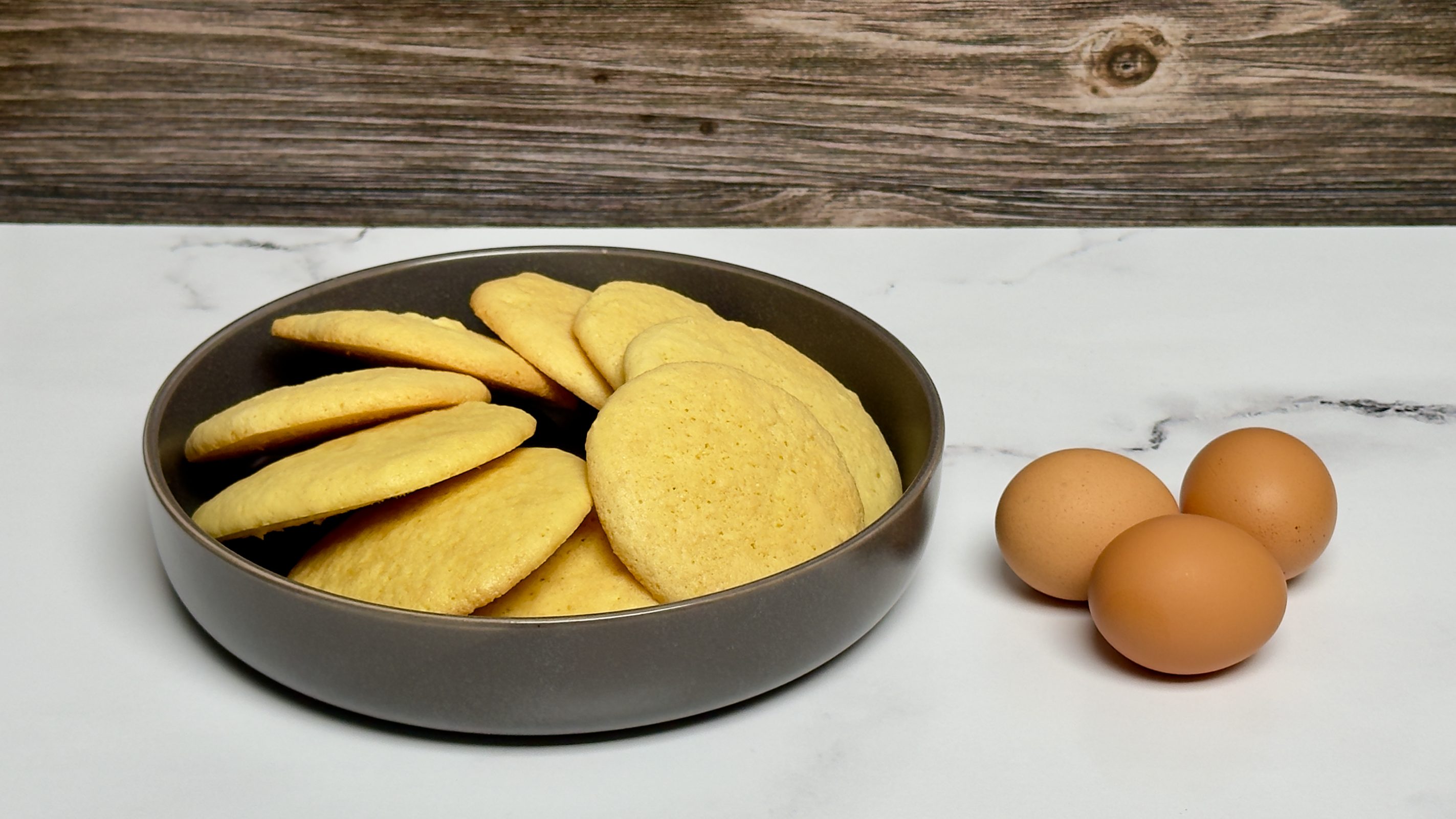
- Place the baking sheet on the center rack of your preheated oven and bake for 10 to 12 minutes. The eierkoeken are done when the edges have turned a light, definite golden brown and the tops look set and dry, though still pale. The tops will not brown much, and that is correct for this bake. If you wait until the tops are golden, you have gone too long and they will be dry. Watch the edges, and pull the sheet from the oven the moment that golden ring appears around each cake.
- Cool on the sheet, then transferLeave the eierkoeken on the hot baking sheet for 5 minutes after you remove them from the oven. They are too soft to move immediately and will tear if you try. After 5 minutes, use a thin spatula to transfer them carefully to a wire cooling rack. Let them cool fully before stacking or storing.
Nutrition
Notes
On Vanilla Sugar: Vanilla sugar is a staple in Dutch baking and you can find it easily online; the Dr. Oetker sachets are widely available on Amazon and in some specialty grocery stores. If you cannot find it, stir 1/2 teaspoon of pure vanilla extract into the eggs at the start of beating, and simply use the full 130 g of regular sugar.
On egg temperature: Eggs that are cold from the fridge will not whip up as fully as eggs that have had time to come to room temperature. Take them out 20 to 30 minutes before you start baking. If you forgot, place them in a bowl of warm (not hot) water for 10 minutes, and they will be ready to go.
